You had cataract surgery, your vision improved, and you felt great. Months or even years passed; then one day you noticed that your vision started to blur again, and lights became bothersome. Your first thought was probably: ‘Has my cataract come back?’ No, but something is indeed happening in your eye, and we call this condition secondary cataract.
What Is Secondary Cataract?
Let us state this clearly first: cataract does not truly recur after cataract surgery. During the operation, the eye’s natural lens is completely removed and replaced with a permanent artificial lens. The removed lens does not come back; therefore, technically speaking, cataract does not relapse.
So why does vision deteriorate again? The answer lies in a thin membrane called the posterior capsule gradually losing its transparency. During cataract surgery, while the natural lens is being removed, the back portion of the capsule surrounding it is left in the eye to hold the artificial lens in place. The clouding of this membrane, that is, its loss of transparency, over the following months or years is called secondary cataract, or in medical terminology, posterior capsule opacification (PCO).
You can compare this to a window: the glass has been broken and replaced with a new one, but the window frame is old. Over time, moisture and dirt on the frame begin to blur the view inside. What happens in the posterior capsule is quite similar to this.
Why Do Some Patients Develop Secondary Cataract While Others Do Not?
This is the real question on many patients’ minds, yet one that most competing websites gloss over. Secondary cataract can develop in some patients as early as 6 months after surgery, while in others it may not appear at all for 5 years. There are multiple reasons for this difference:
- Age: Younger patients are more prone to developing secondary cataract due to the faster proliferation of lens epithelial cells. In children, this is nearly inevitable.
- Type of artificial lens used: Sharp-edged acrylic lenses physically prevent cell migration on the posterior capsule more effectively than soft-edged ones. For this reason, modern lens designs have significantly reduced the rate of secondary cataract.
- Systemic diseases: Diabetes, autoimmune diseases, and long-term corticosteroid (cortisone) use increase the risk of posterior capsule opacification.
- Amount of cells remaining in the capsule during surgery: The more meticulously the cells on the anterior surface of the capsule are cleaned during surgery, the lower the risk of secondary cataract development.
- Intraocular inflammation (uveitis): In individuals with chronic uveitis, posterior capsule opacification progresses much more rapidly and severely.
- Genetic predisposition: It is known that some individuals’ lens epithelial cells tend to grow more aggressively; research on this subject is still ongoing.
In short, secondary cataract is not the result of a ‘poor’ surgery, but rather a consequence of the eye’s own biology. It is observed in approximately twenty to thirty percent of patients within two to five years following surgery.
What Are the Symptoms of Secondary Cataract? When Should You Suspect It?
The most insidious aspect of secondary cataract is that it does not appear suddenly. It progresses gradually in most cases, and the patient initially interprets this as ‘a change in glasses prescription’ or ‘eye fatigue.’ Being aware of this is critically important for early consultation. The symptoms to watch out for can be listed as follows:
- Gradual decrease in visual clarity: A person who regained clear vision after surgery notices a progressive blurring over a period of months.
- Excessive light sensitivity and halos: Light rings (halos) or glare are observed especially around car headlights or strong light bulbs at night.
- Decrease in contrast sensitivity: Distinguishing between objects of similar colors becomes difficult. For example, reading grey text on a white background becomes harder.
- Colors appearing faded: Yellow and blue tones in particular lose their former vibrancy.
- Double vision or ghost images: In some patients, double images may occur even when looking with a single eye.
- Difficulty reading: Following lines and reading small print becomes increasingly challenging.
Important note: All of these symptoms can also be seen in other eye diseases. For this reason, every patient experiencing these complaints…”
How Is the Diagnosis Made?
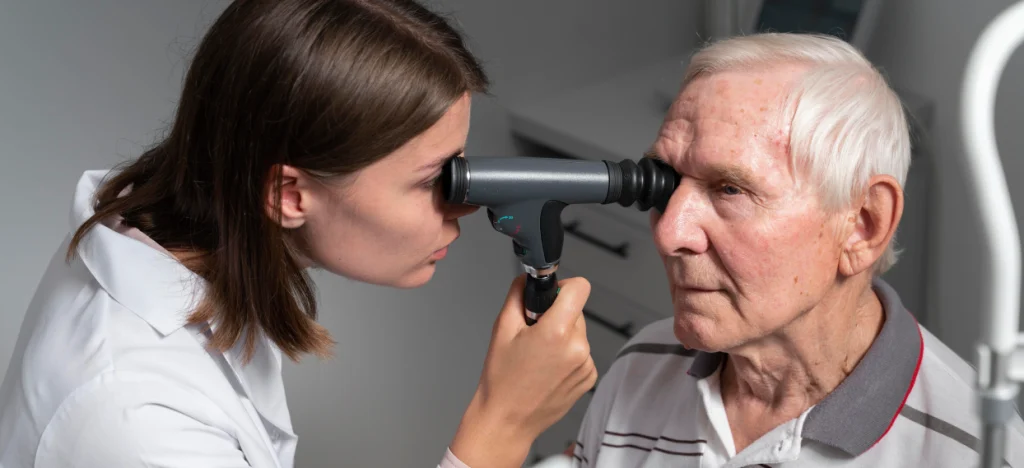
Secondary cataract is diagnosed through a simple eye examination that can be performed in the clinic. The ophthalmologist directly observes the posterior capsule of the eye using a device called a slit lamp (biomicroscope). After applying drops to dilate the pupil, the opacification in the posterior capsule can be assessed with ease.
When the patient’s reported complaints, visual acuity tests, and biomicroscope findings are evaluated together, the diagnosis is quite clear. Additional advanced examinations are generally not required.

What Is YAG Laser?
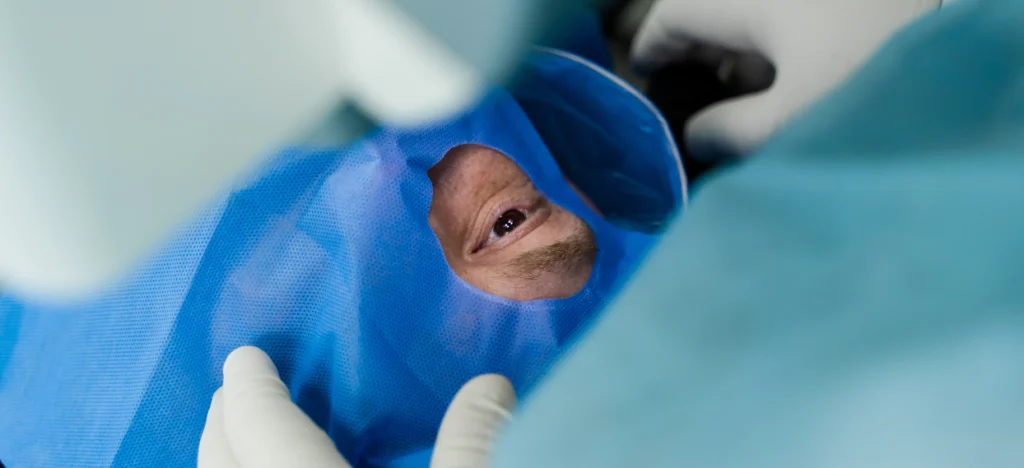
The treatment of secondary cataract is extremely fast, painless, and non-surgical. That is, there is no need for hospitalization, entering an operating room, or general anesthesia.
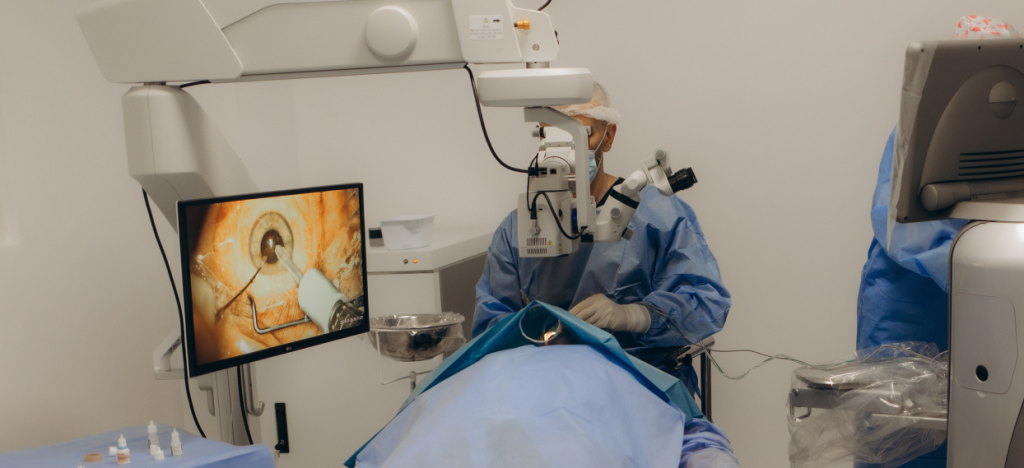
The procedure applied is called YAG laser. In this procedure, the ophthalmologist uses a specialized laser device to create a small opening in the center of the opaque membrane in the posterior capsule. Thanks to this opening, light can pass through properly again and the patient regains visual clarity.
How Does the Procedure Work?
- Drops are applied in the clinic to dilate the pupil.
- Anesthetic drops are instilled to numb the surface of the eye.
- The patient sits in front of the laser device and maintains a steady gaze for a period of time.
- The physician focuses the laser beams on the center of the posterior capsule and the opening is created within a few seconds.
- The procedure generally takes 3 to 5 minutes.
- The patient experiences a noticeable improvement in vision on the same day or at the latest the following day.
The deterioration of vision after cataract surgery drives many people into a panic and leads them to think that the surgery has failed. However, what is actually happening in most cases is secondary cataract, that is, posterior capsule opacification. This condition is not a recurrence of the disease, but rather the result of a biological process of the eye.
The good news is that secondary cataract is treated extremely effectively with a simple laser procedure lasting only a few minutes. The results are generally fast and permanent.